Rabu, 23 Maret 2011

New! Rich Media Metrics in DFA Analytics(beta)

The power of DFA Analytics rests in its visually-driven views of campaign performance with easy-to-understand charts and graphs. Drill-down reporting allows you to view performance at multiple levels and across dimensions such as geography, browser, operating system and connection speed, regardless of whether targeting was implemented during campaign setup.

We’re pleased to announce that with this latest release of DFA Analytics, we’re making the tool even more powerful by incorporating standard DoubleClick Rich Media metrics. New metrics include:

  • Impressions
  • Click Rate
  • Backup Image
  • Average Display Time
  • Interaction Rate and Time
  • Number of Expansions and Expansion Time
  • Number of Video Plays and Average Video View Time

DFA Analytics updates the data continuously throughout the day and provides you with a quick and easy way to glance at reporting and verify that your recently trafficked campaigns have gone live and are running smoothly. For example, you could monitor potential issues with your campaign by checking on the number of backup images being served up.

Rich Media metrics in DFA Analytics also allow you to drill down your analysis to any level, from account on down to advertisers, campaign, site, ad and creative. Graph results to compare different Rich Media metrics such as the average display time against average video view time over time. Get deeper insight into how your campaign is performing over time by charting results by day, week or month. Go further by benchmarking a campaign’s interaction rate against that of the whole advertiser. Or get a quick pulse on the success of your in-banner video ads by viewing the number of video plays your campaign is receiving.

We’re continuously adding new features to DoubleClick for Advertisers, so expect to see frequent improvements to DFA Analytics in the coming months.

Selasa, 22 Maret 2011

Your life as a search professional is about to get much easier


(Cross-posted from the DoubleClick Search blog)

DoubleClick Search began in 2006, a tool for larger agencies and advertisers running large-scale online advertising campaigns across multiple platforms. It’s designed to manage the execution of paid search campaigns and centralize the measurement of performance across search and display advertising.


Think of search campaign management like an air traffic control system: directing one airplane to take off from a given airport at the right time is relatively simple. Coordinating thousands of airplanes, across many airports is more complex. The same is true of search campaigns: managing a search campaign is easy, but managing multiple campaigns and search engines, and comparing performance of search and display strategies, can be more difficult.

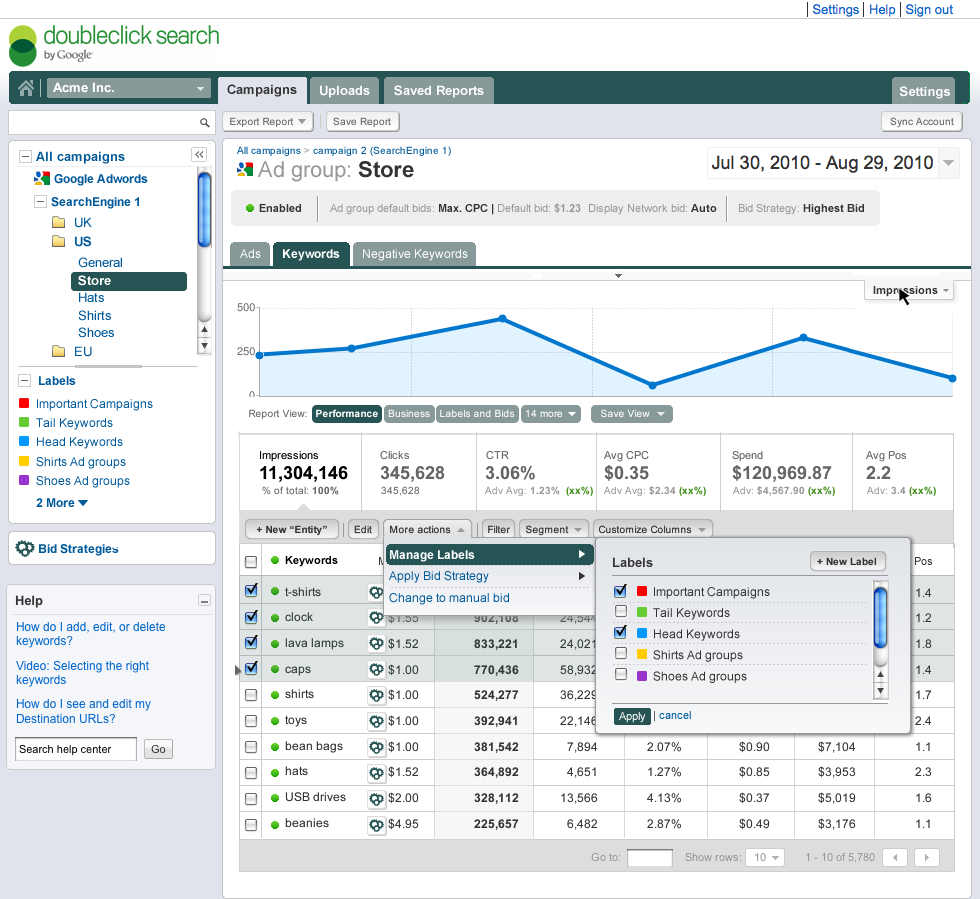
Today at SES New York, we’re giving the first glimpse of the latest version of DoubleClick Search (version 3), designed to make these tasks simpler.

We’ve spent the last 9 months talking to our customers and agency partners about what you want from a search campaign management tool, and we’ve heard you loud and clear: you want a powerful solution that lets you manage millions of keywords, across the leading search engines, from a fast, easy-to-use platform. So we took a look at our existing DoubleClick Search product and decided to rebuild it from scratch, designing it to take the activities you do on a daily basis and make them simpler, faster and more effective.

We are currently beta testing DoubleClick Search v3 with select partners and will be rolling it out to all partners later this year. Here are a few ways we’ve made our DoubleClick Search product better:

Workflow: We’ve simplified navigation with an easy-to-use, AdWords-like interface and enabled you make changes to your campaign directly from DoubleClick Search or directly in the search engines. We’ve also added the ability to upload campaigns in spreadsheets with up to 1 million rows, and manage campaigns globally with many language and currency options.

Reporting: DoubleClick Search now includes powerful filters and labels that allow you to highlight important keywords. Our revamped reporting features also allow you to manage where your ads appear with precise position controls, design your bidding strategy to meet specific ROI goals, and compare how your campaigns are performing across search and display, thanks to seamless integration with DoubleClick’s display platform, DoubleClick for Advertisers.

Optimization: We’ve given you new tools to enhance optimization, including the ability to view performance data across all the major search engines and a customizable reporting view so you can focus on what matters most to your business.

Here is a sneak peek at what the new DoubleClick Search will look like:


(Mock screenshot)

There will be more news in the weeks and months ahead, so please be sure to check back at our DoubleClick Search blog.

Posted by: Ariel Bardin, Director of Product Management

Kamis, 17 Maret 2011

Simplifying Conversion Tracking in DFA: Floodlight is the new Spotlight

This past week we made a big step to simplify conversion tracking in DoubleClick for Advertisers (DFA). Now by default all tags in DFA will be referred to as “Floodlight” tags, and “Spotlight” as a name is being retired in the system.

Our goal is to make conversion tracking easier to understand while enabling more of our customers to take full advantage of our most up-to-date conversion tracking technology using iFrames.

So where you used to see the term “Spotlight” in the interface, you will now see “Floodlight in its place. For example, as you can see in this screenshot, the tabs formerly labeled as Spotlight Configuration and Spotlight Activities are now labeled Floodlight Configuration and Floodlight Activities.

Another instance where you will notice the change is in ReportCentral, where queries with “Spotlight” in the name will now show up as “Floodlight” instead. The Shared Spotlight report is now named the Shared Floodlight report, for example. Field names and metric definitions have been updated, but all data will be calculated the same way as before.

Permissioning for dynamic tags
Previously, the key feature of Floodlight was dynamic tags — the default and publisher tags that you can use to deliver additional code whenever your Floodlight activities are triggered.

If Floodlight was enabled for your DFA account prior to March 12, you can automatically use dynamic tags with all of your advertisers. Advertisers that were previously using Floodlight will have dynamic tags enabled automatically. To switch them on for other advertisers, just go to the Floodlight Configuration tab for the advertiser.

By default, dynamic tags are not available for new DFA accounts or for accounts that were not enabled for Floodlight before March 12. To begin using dynamic tags, at no additional charge, you'll need to sign an agreement with us, similar to the agreement required previously to use Floodlight.

Easy to switch back to image tags
If there are certain instances where you prefer to serve an image tag (what use to be referred to as a Spotlight tag) instead, you can easily switch to using image tags for a single activity, all activities within an advertiser, or across all activities in your DFA account.

No retagging required
The good news is that no retagging is required. All of your existing tags — both Spotlight and Floodlight — created before March 12 will continue to work as normal.

Simplifying conversion tags is just one of many enhancements to DFA over the course of 2011 to ensure it is the most efficient, easy-to-use and integrated ad serving system available.

Rabu, 16 Maret 2011

Preview DoubleClick Search V3 on March 22 at SES in NYC

(Cross-posted from the DoubleClick Search blog)

Over the past few months, we've been hard at work on a brand new version of DoubleClick Search. With significant improvements in workflow, optimization, and reporting, DoubleClick Search V3 was built to make your life as a search professional much easier.


Please come see DoubleClick Search V3 and meet the AdWords and DoubleClick Search executive team. The session will take place on March 22 from 1:30 PM to 2:30 PM at SES New York. 


Also, visit our booth in the Expo Hall (#1001) for a personal meeting with the AdWords and DoubleClick Search team. 
We're looking forward seeing you at SES in NYC.

Senin, 28 Februari 2011

Less Shopping and More Travel: Two Top Trends for the January 2011 Ad Planner 1000

A new year often means new resolutions, a time to recover from the excesses of the holiday season and plan for the new year. As reflected in January’s Ad Planner 1000, anyway, it seems that less shopping, tax season and travel are particularly top of mind with people navigating the web.

With the holiday season over retail sites took a hit in January as it appears consumers have scaled back on purchases - at least in the online world. Popular sites in the AP 1000 such as target.com (-40%), shoplocal.com (-38%), kohls.com (-38%), bestbuy.com (-35%), walmart.com (-35%) and sears.com (-32%) all saw significant declines in the number of unique visitors to their site from the month before. But special deals to counteract the expected drop in retail sales can work magic - as it did in for the deal site, livingsocial.com. Its Amazon.com $20-for-$10 offer resulted in over 1.3 million vouchers sold and a 47% increase in the number of visitors to its site for that month.

And while people are spending less, they might be hoping to see tax refunds, and thus the appearances of two tax-related sites in the January list: the irs.gov entered the list at #449 and intuit.com, makers of the popular TurboTax software, entered at #321.

It’s possible that finding new jobs and new destinations are popular resolutions this year if the surge in traffic to career and travel sites are any indication. Job search site indeed.com (+26%) saw more than a quarter of their unique visitors increase in January and sites careerbuilder.com (+21%) and monster.com (+20%) also fared well with increases in traffic from the month before.

The increase in visitors to travel-related sites was particularly notable in January’s AP 1000 list. Tripadvisor.com (+33%), booking.com (+33%), orbitz.com (+31%), travelocity.com (+31%) -- all saw more than a third more unique visitors to their site than in December. While sites hotels.com (+29%), expedia.com (+21%), easyjet.com (+20%) and priceline.com (+16%) also saw notable boosts in traffic.

Check back with us next month to see when we publish the data for February’s AP 1000. We’re looking forward to seeing how cupid’s arrow will work his magic on sites in the AP 1000 list.

Rabu, 23 Februari 2011

Real-Time Display Advertising State of the Industry

The ability to buy and sell impressions in real-time is a major enabling feature of the fundamental changes powering the display marketplace today. Impressions are coming up for sale as they occur in real-time. Savvy buyers are evaluating these impressions and making data-driven decisions about their value. Display advertising is becoming more accountable, scalable and lucrative.

To learn more about this real-time trend, we recently undertook an industry study with Digiday, surveying more than 300 digital media buyers, agencies, intermediaries and publishers about their thoughts on real-time display advertising. Highlights from these findings will be presented today at DIGIDAY:ONMEDIA in Los Angeles. Some of the revealing findings include:

  • 88% of buyers plan to buy via RTB in 2011, up from 75% last year.

  • 47% of media buyers say that the benefits or RTB will increase their overall digital advertising budget this year (16% said it would not, 37% were unsure).

  • Spending on RTB is quickly moving out of the "test budget" range: 79% of buyers estimate that more than 10% of their digital display budgets will go to RTB in 2011. 33% estimate that 50% or more of their digital display budget will go to RTB. And 7% estimate 90-100% of their digital display budget will go to RTB.

  • 29% of media intermediaries (such as DSPs, ad networks, and exchanges) anticipate their volume of real-time bidding will increase by 100% or more versus last year. 19% believe it will go up by at least 200%.

  • More formats are moving to RTB: 34% of buyers say they are extremely or very likely to purchase rich media ads via RTB this year, 32% are extremely or very likely to purchase dynamic creative ads via RTB, 20% are extremely or very likely to purchase mobile display ads via RTB, 18% are extremely or very likely to purchase in-stream video via RTB and 14% are extremely or very likely to purchase mobile rich media via RTB.

  • Nearly half (48%) of publishers surveyed say they plan to increase the amount of inventory they will make available via RTB. 28% are still deciding. Only 24% said they were not planning to increase RTB inventory.

Real-time bidding is a major enabling force behind this sea change in the way digital media is transacted in today’s advertising marketplace. Yet, RTB is just part of an explosion of technology advancements in display. Read more about this technological Big Bang.

Selasa, 22 Februari 2011

Coming Soon: New Agency and Advertiser Pages in DoubleClick Search


(originally posted on the DoubleClick Search Blog)

In the blog post from January 18, we mentioned that we’ve been working on an updated version of DoubleClick Search, called V3. We’ll soon be introducing some of the features from V3 to the current version of DoubleClick Search: the new Agency Home and Advertiser Home pages. In addition, we'll be adding a unified DoubleClick Search sign-in page on the Google domain. Benefits include:
  • Performance: This move to the Google infrastructure will provide a faster and more stable environment for DoubleClick Search with the Agency/Advertiser release, and allow us to make product changes more quickly in future releases.
  • Instance consolidation: You'll be able to access agencies and advertisers from all instances at one sign-in page.
  • Workflow: It will be easier and faster to select agencies and advertisers, to display only the advertisers that matter to you, and to access the Reporting Center.
  • Preparation for V3: These changes will help to pave the way for even bigger changes in the coming months: the full release of the updated DoubleClick Search V3! Come see us at SES in NYC on March 22 for the premiere of DoubleClick Search V3.
To see a preview of the DoubleClick Search Home release, sign up for the webinar on February 24.